Introduction
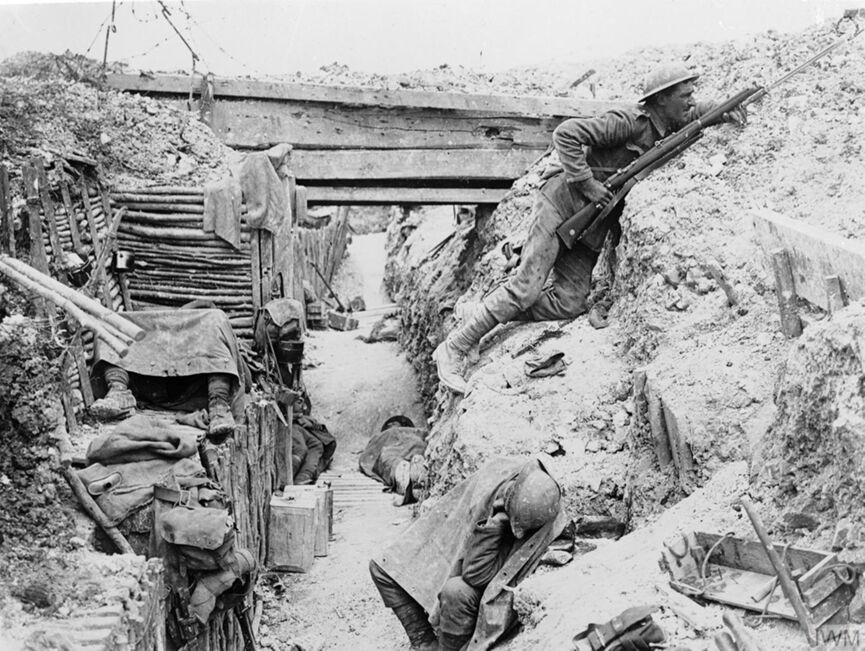
The photograph that I chose is from The Battle of the Somme which took place during WWI (July to November 1916), and it was one of the largest and bloodiest battles of that war. It started out as a joint operation between the British and French troops (who were part of the Allies) against German forces by the Western Front near the Somme River in France. The battle ensued for five months as a trench warfare and in the end there were more than 1 million soldiers who had been killed or wounded. In the end despite its horrific costs the Allies were successful in pushing the German military back from that place. The question I will be exploring is whether this work is in the public domain, or if copyright limits the use.
Copyright Analysis
The photograph was taken on July 1916 by Lieutenant John Warwick Brook and the production date is from 1916-1917 by the Ministry of Information First World War Official Collection. Regarding the ownership or who would have claim to this photo it would most likely be the Imperial War Museums (IWM). From what I gathered the work is likely to be a public domain which means it could be reused for Personal use, for non-commercial research, a private study, Free exhibitions held in venues, which do not charge an entry fee. I also found information on how you mustn’t mislead others or knowingly misrepresent the Information or its source, apply your own watermarks, logos or any other content to the Information, and any use of the Information in a way that suggests that IWM or any third party rights holder endorses you or your use of the Information. I also went on Creative Commons to check which licensing would be appropriate and the CC BY-NC is the closest match.
Course Readings:
The readings that apply to my case are the “owning the past” in digital history by Dan Cohen and Roy Rosenzweig and video “The Amen Break”. First reason that “Owning the past” is related to the photo I chose is because that photo serves for a “fair” educational purpose and it evens talks about what is fair? “Section 107 of the 1976 Copyright Act explains that “fair use of a copyrighted work … for purposes such as criticism, comment, news reporting, teaching (including multiple copies for classroom use), scholarship, or research, is not an infringement of copyright” This photo does exactly that like I said. But also the photo has mention of who took it and the year as well which gives credit. The Amen Break also applies to the photo I chose because in the video it mentions how using something that is in the public domain is the start for creative works. Although the Amen Break is only 6 seconds long it was enough to help create many other famous works with hip hop and a famous song such as straight out of Compton. If the owner of “the Amen break” had been more private and aggressive about his work, then he could’ve gone after the people who had been remixing his work. I believe it became a public domain since other artists were remixing it and using it as “an attempt make new from something old” as mentioned in the video too.
Implications:
Historians, educators, and Archivists get affected by copyright status in the way they’re allowed to present the information that they gathered. The public domain images like the one I chose allows the researchers to tell a more complete story or stories. Copyright also affects museums, digital archives, and classrooms in that the historical material is able to be freely accessed which helps with the collaboration, and transparency. Now the question of whether there are ethical concerns about limiting access to the historical document or image? And the answer would have to be yes. With the restriction it’s possible to limit what is accessed and also used appropriately. I also believe that all historical documents and images should be freely accessible, but the users should access it with care, and respect to make sure that those public domain contents remain easily accessible for future works.
Conclusion:
The photograph of the Battle of Somme stands as a record of wartime and a accessible public history. That is because it is in a public domain and historians, educators and archivists can use it to show a true story and event of what war brings without many legal obstacles. And I believe that copyright laws should change to allow more historical material freely available to the public.
Works Cited
What was the battle of the somme? | imperial war museums. Accessed October 24, 2025. https://www.iwm.org.uk/history/what-was-the-battle-of-the-somme.
Cohen, Dan, and Roy Rosenzweig. “Owning the Past? The Digital Historian’s Guide to Copyright and Intellectual Property.” Digital History: A Guide to Gathering, Preserving, and Presenting the Past on the Web, Center for History and New Media, George Mason University, n.d., Digital History | Owning the Past?, Accessed 21 Oct. 2025.
The Omen Break
YouTube. Accessed October 23, 2025. https://youtu.be/5SaFTm2bcac?si=YZhYCdfreX3uJaML.